
The Snow Geese Are Back! An Incredible Arctic Migration Brings Tens of Thousands of Birds to the Skagit Valley
Every fall tens of thousands of snow geese arrive in the Skagit Valley after an epic journey from the Russian Arctic. We dive into what makes their migration so fascinating and where you can experience it for yourself.
There's something pretty magical about the Skagit Valley in the fall. The summer crowds have disappeared, the fields have been harvested, and Mount Baker is beginning to collect its winter coat of snow. But one of our favorite signs that the seasons are changing isn't happening on the ground. It's happening in the sky.
Every autumn tens of thousands of snow geese descend on the agricultural fields and coastal wetlands of the Puget Sound watershed, transforming the landscape into one of the most spectacular wildlife-watching destinations in the Pacific Northwest.
If you've ever driven through Fir Island on a chilly November morning and witnessed thousands of snow geese suddenly taking flight, you know exactly what we're talking about. The sound alone is unforgettable.
But what's even more incredible is the journey these birds have made to get here.
All the Way From Russia, With Love
The snow geese that spend their winters in the Skagit Valley aren't exactly local. In fact, they've traveled thousands of miles to get here.
Most belong to a population of lesser snow geese (Anser caerulescens caerulescens) that breeds on Wrangel Island, a remote Arctic island off the northeastern coast of Siberia, Russia.
Located in the Arctic Ocean between the Chukchi and East Siberian seas, Wrangel Island is an extraordinary place. Its tundra provides summer nesting habitat for snow geese, which take advantage of the Arctic's long daylight hours and brief growing season to raise their young.
As summer ends and temperatures begin dropping, the geese prepare for their annual migration south.
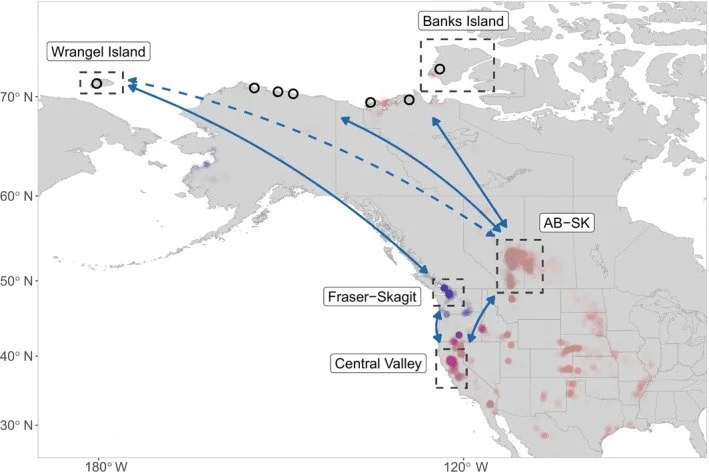
Breeding colonies (open circles), band recovery locations (dots), and the key areas (rectangles) used by snow geese breeding in the Western Arctic and Wrangel Island. Recoveries are from birds banded in 1970–2021 across the study area. Red and blue dots denote recoveries from birds banded in the Western Arctic and Wrangel Island, respectively. Dots are transparent to highlight the regions with most recoveries. Rectangles highlight the approximate locations of the largest breeding colonies (on Wrangel and Banks islands) and the main wintering (Central Valley of California, Fraser, and Skagit river deltas) and stopover (Alberta and Western Saskatchewan) sites. Arrows denote main migratory directions. The dashed arrow denotes a minor migration corridor between Wrangel Island and the stopover site in Alberta‐Saskatchewan. Small number of recoveries south of 25° N are left outside the map. (Map: Piironen, Antti, Jeffrey M. Knetter, Kyle A. Spragens, Joshua L. Dooley, Vijay Patil, Eric T. Reed, Megan Ross, et al. 2025. “ Environmental Drivers of Productivity Explain Population Patterns of an Arctic-Nesting Bird across a Half-Century.” Ecological Applications 35(5): e70067. https://doi.org/10.1002/eap.70067)
Following the Pacific Flyway, a major migratory corridor stretching along western North America, they travel through Alaska and western Canada toward their wintering grounds.
For many, that means the Fraser River Delta in British Columbia and the Skagit River Delta in Washington. Others winter farther south, including California's Central Valley.
The journey from Wrangel Island to the Salish Sea covers roughly 3,000 miles, making the arrival of these birds all the more remarkable.
Snow geese are also incredibly social birds. Family groups often remain together during migration and through the winter, with young birds learning important feeding and survival behaviors from their parents.
That means some of those grayish youngsters you see wandering around the muddy Skagit fields are experiencing their very first Pacific Northwest winter.

Why Do Snow Geese Love the Skagit Valley?
As it turns out, the Skagit Valley is a pretty fantastic place to spend the winter, especially if you're a hungry goose.
The region offers an ideal combination of agricultural fields, coastal wetlands, protected estuaries, and relatively mild winter temperatures.
Snow geese are primarily herbivores, feeding on grasses, sedges, roots, tubers, and agricultural crops. The Skagit’s extensive farmland provides abundant opportunities to forage, while the surrounding bays, estuaries, and tidal habitats provide places to rest and roost.
The relationship between agriculture and migrating wildlife is especially interesting here.
Over generations, snow geese have adapted to feeding in agricultural landscapes, taking advantage of nutritious vegetation and leftover crops. Their enormous winter flocks are now a familiar sight in the fields surrounding Fir Island, Conway, and the Skagit River Delta.
Nearby marine waters are equally important. Open water and tidal habitats provide nighttime roosting areas where large flocks can gather away from many land-based predators.
It’s this combination of working farmland and healthy coastal habitat that makes the Skagit–Fraser region such an important winter destination.
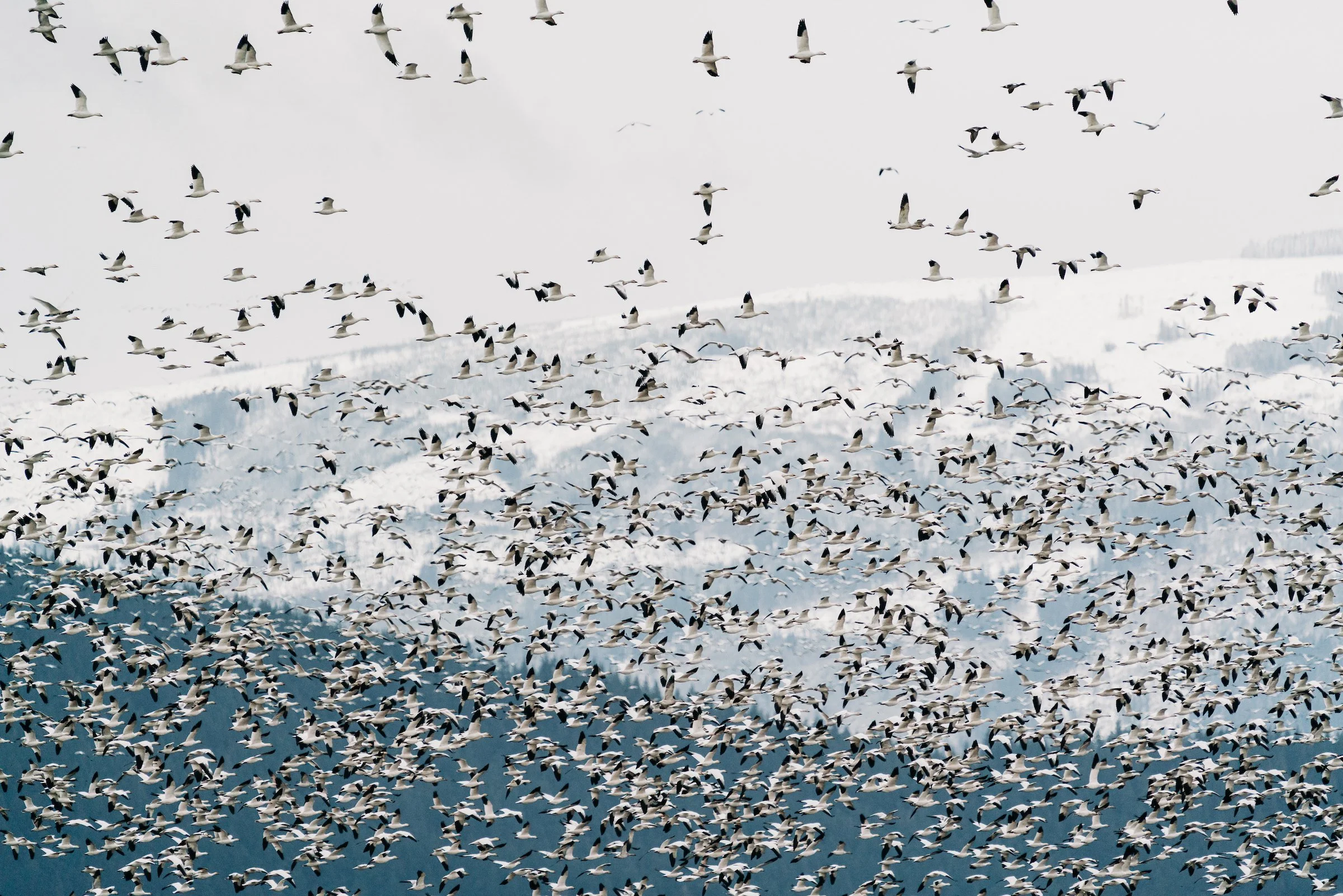
A flock of hundreds of snow geese flying together over the Samish Flats (Photo: Sara Montour Lewis / Our Wild Puget Sound)
Just How Many Snow Geese Are We Talking About?
A whole lot.
Snow goose populations along the Pacific Flyway have experienced remarkable growth over the past several decades.
A major study published in Ecological Applications in 2025 combined more than 50 years of data to reconstruct changes in lesser snow goose populations across the Pacific Flyway. Researchers estimated that the total spring population increased from roughly 300,000 birds in 1970 to nearly 2.4 million in 2022.
That number includes multiple populations across the Pacific Flyway, not just the birds visiting northwest Washington.
The increase among the snow geese connected to Wrangel Island has been especially dramatic.
Researchers estimate that the Wrangel Island population hovered around 100,000 birds for decades before beginning a remarkable increase after 2010. By spring 2022, the population was estimated at roughly 750,000 birds.
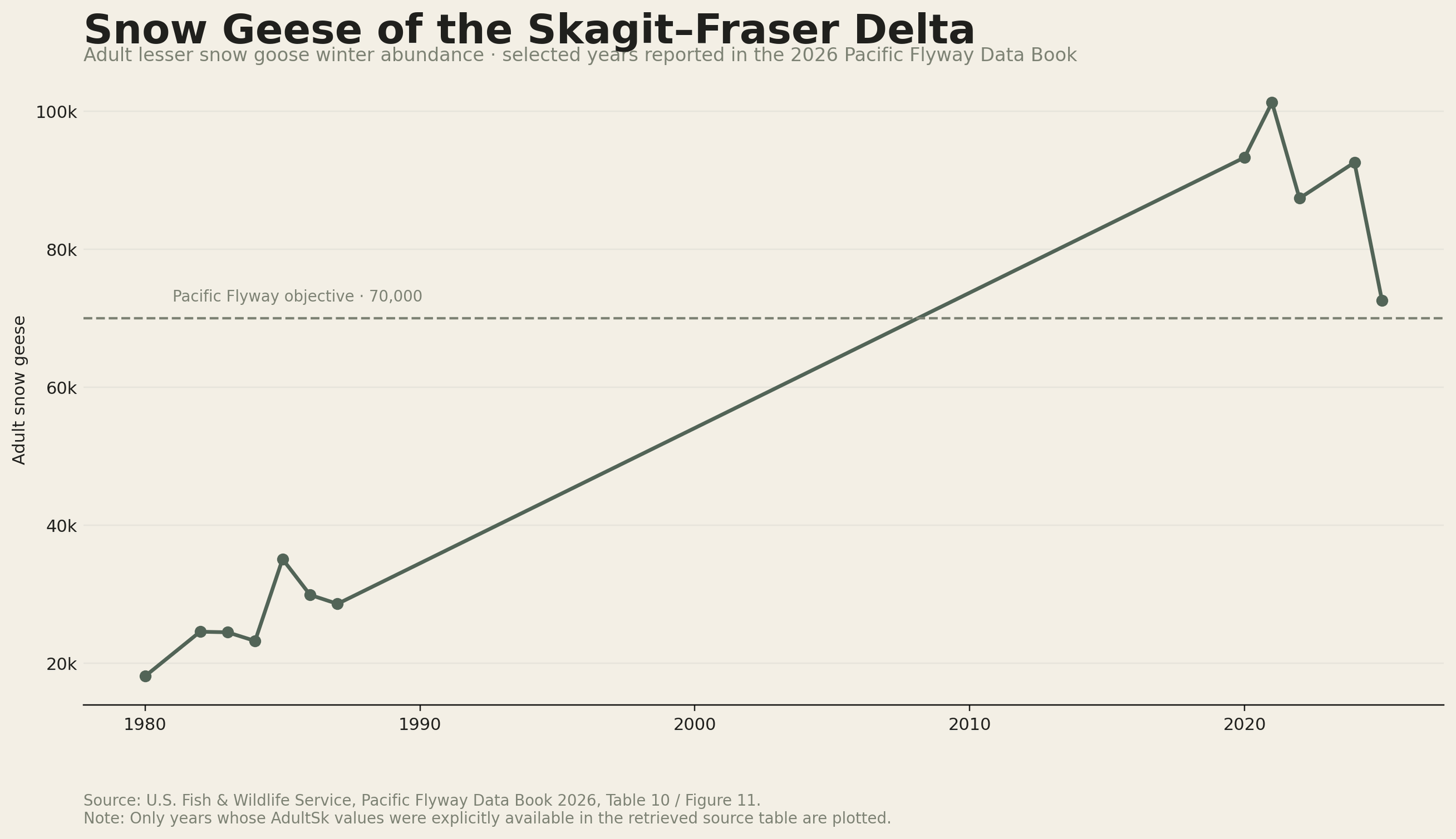
Closer to home, the newest Pacific Flyway data put the 2025 winter index at 72,615 adult snow geese in the combined Skagit–Fraser region of Washington and British Columbia.
Because goose numbers can bounce around considerably from one winter to the next, wildlife managers also use a three-year average to track the population. That current management index stands at about 84,200 adult birds—well above the region’s long-term average of 52,442 and above the Pacific Flyway Council’s population objective of 70,000.
Importantly, those numbers represent the broader Skagit–Fraser wintering region, not the number of geese hanging out in the Skagit Valley itself on any particular day.
And the seemingly enormous difference between the estimated 750,000 Wrangel Island birds and the roughly 73,000 counted in the Skagit–Fraser region isn’t a contradiction. The Wrangel Island figure is a modeled estimate of the broader population during spring, while the Skagit–Fraser number is a winter index of adults using one portion of their winter range. Many Wrangel Island geese winter elsewhere, particularly in California.
Migration, it turns out, is much more complicated than a straight line between two places.
A Winter Wildlife Spectacle
While the geese themselves are impressive, one of the most exciting parts of watching them is seeing how they interact with the other wildlife that calls the Skagit Valley home.
Bald eagles are a particularly dramatic part of the equation.
Snow geese gather in enormous flocks partly because there's safety in numbers. But when a bald eagle approaches, thousands of birds may suddenly launch into the air in a swirling, honking cloud.
It's an absolutely incredible sight.
One moment, a field appears to be covered in a blanket of snow. The next, that entire blanket lifts into the sky.
The flocks twist and turn together, creating constantly changing shapes against the mountains and clouds until they feel safe enough to land back on the field in another collective snowfall.
If you're lucky, you might also spot trumpeter swans, tundra swans, northern harriers, short-eared owls, rough-legged hawks, and so many other winter inhabitants while exploring the surrounding agricultural landscape.
The Skagit and Samish flats are among our favorite places to experience the incredible diversity of birds that depend on the Puget Sound watershed.
When Do Snow Geese Arrive in Washington?
Snow geese generally begin arriving in northwest Washington during late September or early October, although their exact timing varies with weather and conditions along their migration route.
Numbers typically build throughout the late fall, with large flocks present through February. By March many begin their northward migration, eventually returning to Arctic breeding grounds as spring approaches.
The timing of their departure is especially important.
Researchers have found that earlier snowmelt is associated with greater snow goose productivity, likely in part because the timing of snowmelt influences when vegetation becomes available during the brief Arctic growing season. Warmer conditions in early fall have also been associated with better survival among young Wrangel Island geese.
It’s a fascinating connection: the number of young gray geese we see following their parents around a Skagit Valley field in winter can be influenced by weather conditions thousands of miles away on the Russian Arctic tundra months earlier.
Scientists are also getting a better understanding of what has driven the population’s extraordinary growth.
The 2025 study found that year-to-year changes in snow goose numbers were strongly influenced by productivity, or the number of young birds entering the population. Migration also appears to have contributed to the recent rapid increase in the Wrangel Island population, while changes in survival and harvest rates have played important roles over longer periods.
One important caveat is that long-running cooperative field monitoring on Wrangel Island ended in 2022. That means the estimate of approximately 750,000 Wrangel Island birds should be understood specifically as a 2022 spring population estimate, rather than a current 2026 count.
Winter monitoring in the Skagit–Fraser region has continued, which is why we have access to more recent local numbers.
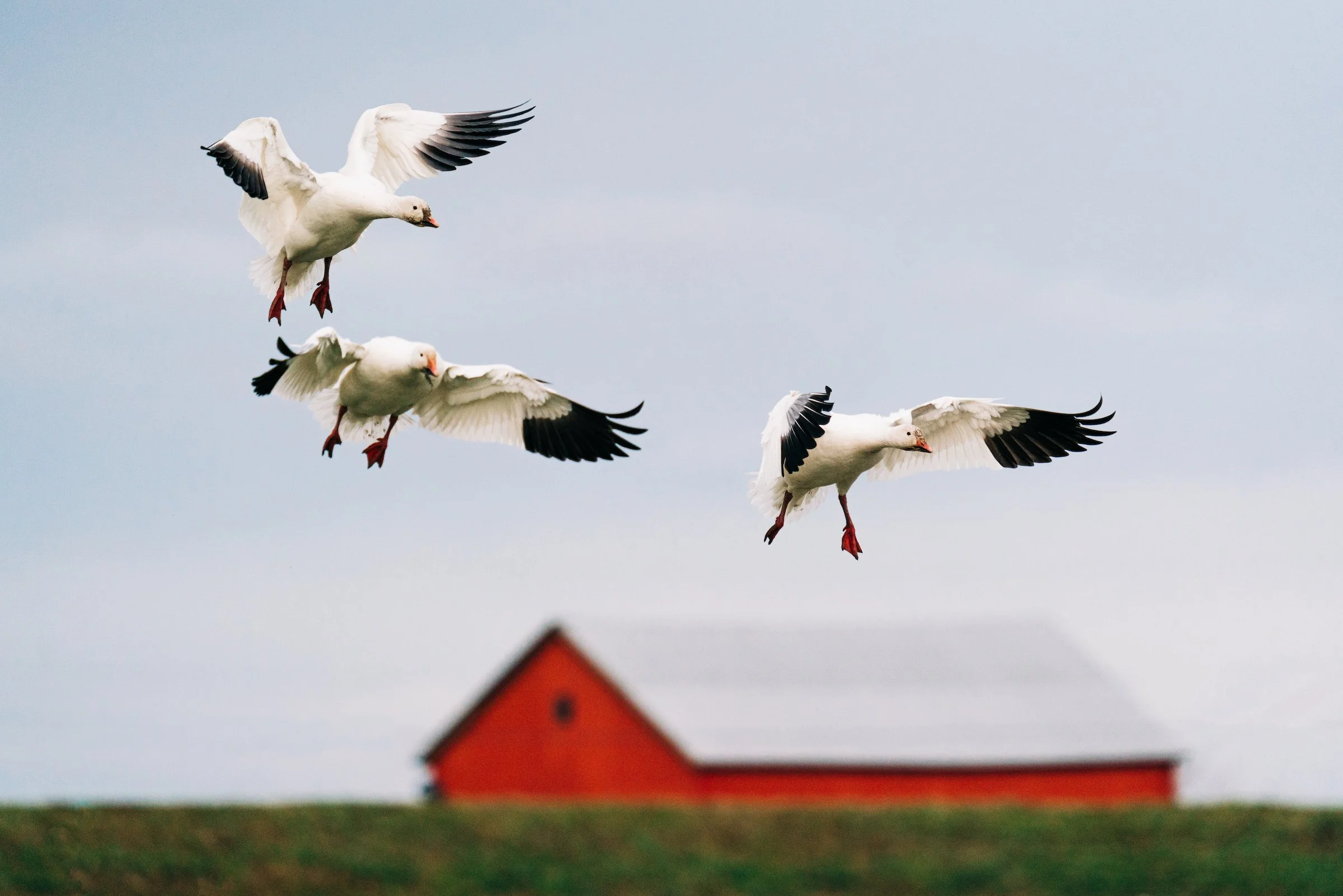
Snow geese landing on a field in the Skagit Valley (Photo: Sara Montour Lewis / Our Wild Puget Sound)
Where to See Snow Geese in the Skagit Valley
Fortunately, this migration is incredibly accessible and you don't need to travel very far, or hike for miles, to be able to witness it.
Some of the best snow goose viewing opportunities are found around Fir Island, particularly along the agricultural roads between Conway and the Skagit River Delta.
The fields near Best Road and Fir Island Road can be especially productive, although the birds move frequently depending on food availability, weather, and disturbances.
For the best experience, plan to visit during the morning or late afternoon, bring binoculars, and give yourself plenty of time to explore.
We like to look at iNaturalist and eBird to get a sense of where the flocks have been congregating lately and then pick a route that hits those hotspots, but it’s largely a game of patience and luck. Some days you’re able to hear them before you see them, so we also recommend driving with your windows cracked to boost your chances.
A Reminder of How Connected Our Wild Places Really Are
One of our favorite things about living near Puget Sound is being able to witness just how connected this landscape is to the rest of the world, and the snow geese are a perfect example.
These birds spend their summers on a remote island in the Russian Arctic, travel across international borders, and arrive each fall in the same agricultural fields and coastal wetlands that we drive past on our way to work, visit on weekend adventures, or explore with our families.
Their survival depends on healthy habitats spread across thousands of miles, spanning several countries. The Arctic tundra, coastal estuaries, working farms, river deltas, and wetlands might look like completely separate landscapes on a map, but to a migrating snow goose, they’re all pieces of the same habitat.
The story of the Skagit Valley snow goose is a perfect reminder that so many of the animals we encounter here have complex lives that extend far beyond the edges of the Salish Sea.
So the next time you’re driving through the Skagit Valley and notice what looks like a giant white cloud moving across a field, pull over somewhere safe and take a moment to watch.
Some of those birds may have traveled roughly 3,000 miles from an island in the Russian Arctic just to spend the winter here.
And honestly, that’s pretty dang cool.
