
That’s An Opalescent Nudibranch! (Or Is It?)
Originally published by The Revelator
A meditation on observation, revision, and the quiet thrill of being wrong — and what all of that means for conservation.
On a good low tide, the ocean lets you borrow a secret. You step over slick rock and sea lettuce and the foam line left behind by the last wave. You squat. You lean in. And there — moving with the confident weirdness of something that has never once asked permission to be beautiful — is a nudibranch.
A sea slug. But also: a small, living argument against the idea that the world is fully cataloged.
It looks like a flame that learned to crawl. A handful of translucent, orange-white fingers (cerata) spilling off its back like a crown of underwater matchheads. Its rhinophores — those faintly ridiculous sensory “ears” — search the water for chemical stories you and I will never smell. It is, in every way, too much for something that small.
If you’ve spent any time around West Coast tide pools or cold-water kelp forests, you may have met it under its most famous name: Hermissenda crassicornis, the thick-horned nudibranch. A staple of field guides. A reliable “oh wow” moment. One of those species that feels like a dependable friend — the kind you can point to and say, with satisfying certainty, “I know what you are.”
Except… the ocean has a way of revealing that certainty is often just a placeholder.
Because this animal has lived a double life inside human language, and the story of its name is a story about how science actually works: not as a straight line, but as a series of increasingly careful second looks.
And if we follow that story all the way through — through old genus assignments, messy reclassifications, and the moment genetics arrived like a bright flashlight — we end up with something worth carrying back out of the tide pools: That observation is not the opposite of mystery. It’s the doorway into it.
The First Name Is Almost Never the Last
In the early 1800s, naturalists were describing the ocean the way astronomers once described the night sky: urgently, joyfully, and with limited tools. A new creature didn’t arrive with a barcode and a phylogenetic tree. It arrived as a specimen and a sketch and a best guess.
In 1831 this nudibranch was described as Eolis crassicornis. That first genus — Eolis — was, in hindsight, a kind of temporary holding pen (nudibranchs fall broadly into two camps: aeolids — slender, cerata-fringed; and dorids — their flatter, smoother, pancake-shaped cousins). A large, convenient bucket for aeolid nudibranchs that looked broadly similar: slender body, rows of cerata, a vibe of delicate menace. It made sense at the time. The world was being named faster than it could be sorted.
But “temporary” is one of the most honest words in taxonomy.
As the field matured, the bucket cracked. Different researchers began splitting Eolis apart, not because they were bored, but because close observation kept forcing the issue. Anatomical details mattered: tooth shape on the radula, the arrangement and structure of cerata, the form of rhinophores, internal reproductive anatomy — traits that don’t show up in a casual glance, but that change everything once you learn to see them.
So Eolis crassicornis migrated through the scientific literature, as species do, like a traveler changing trains.
At one stage you’ll find them wearing another name: Phidiana crassicornis. This was not a new species. Not a different animal. This was the same creature — same tide pools, same flash of orange-white, same little dragon energy — placed into a different genus because it seemed, by the best comparative anatomy of the time, to fit there.
And that “seemed” is doing heroic work. Because science is a system built to update itself. A species can be moved into a new genus when new information makes the old placement less defensible. The name changes because our understanding changes. And in that sense, the name is not just a label — it’s a hypothesis.
“Phidiana crassicornis” was a hypothesis. And later, it stopped being the best one.
Eventually consensus shifted. This species didn’t belong in Phidiana after all. It belonged in Hermissenda — a genus erected to separate these animals from similar-looking aeolids that were not, on closer inspection, their closest kin.
So now we meet it in modern references as Hermissenda crassicornis. A satisfying landing spot. A corrected placement. A name that sounds like it belongs to something elegant and slightly mischievous. The story, at that point, feels complete.
Except it wasn’t.
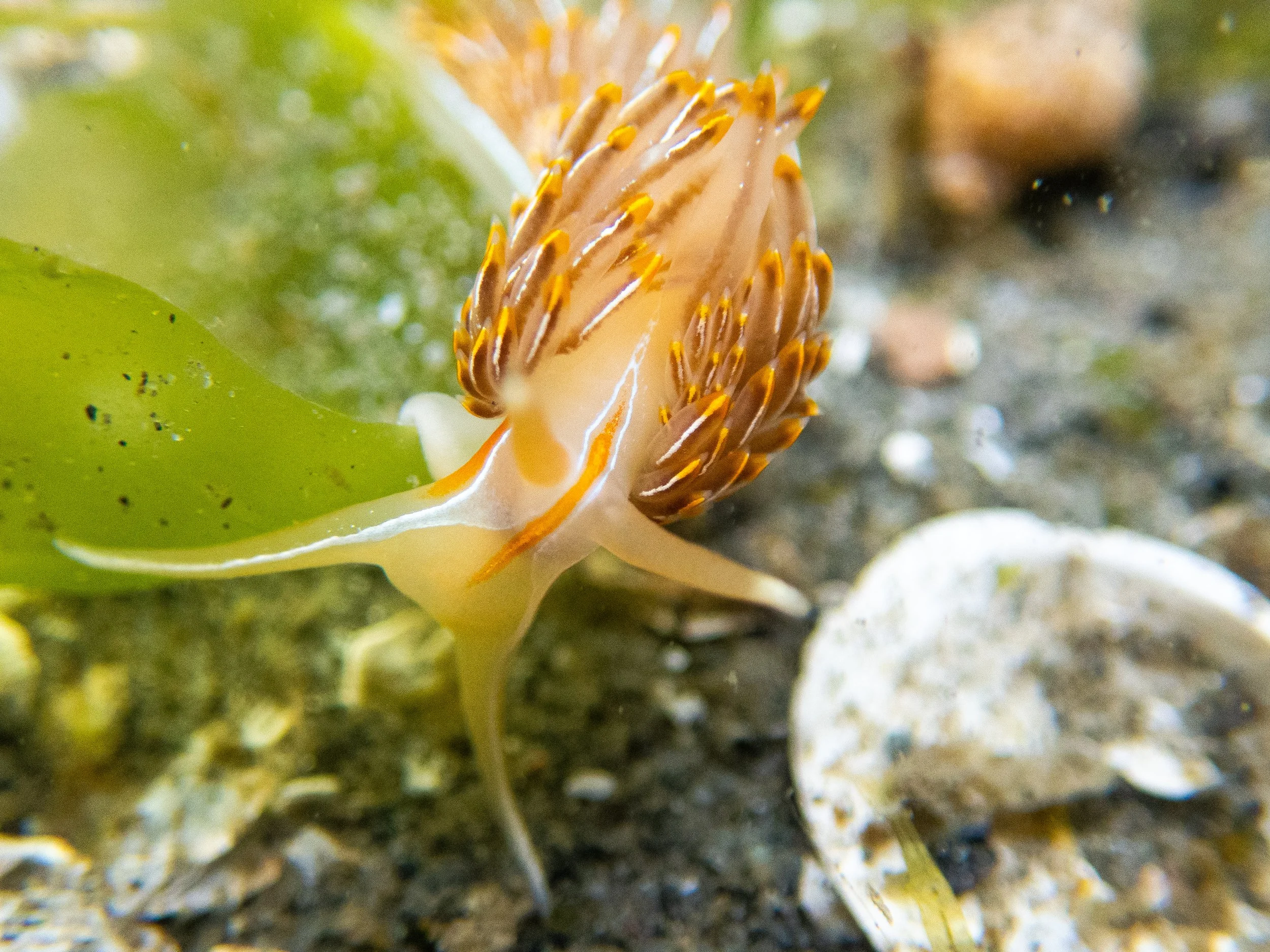
(Photo: Sara Montour Lewis | Our Wild Puget Sound)
The Most Dangerous Word in Biology Is ‘Obviously’
Ask a room full of tide poolers what Hermissenda crassicornis looks like and you’ll get the same answer from all of them. It’ll be right, too — until it isn’t. Because the ocean loves lookalikes.
Sometimes evolution builds the same kind of body again and again, like a composer returning to a familiar chord progression. Sometimes different species wear the same outfit because it works. Sometimes they’re genuinely close relatives and sometimes they’re strangers who just happen to share a costume.
And sometimes — this is the part that gets under your skin — you can stare at an animal for years and still not know that you’re staring at more than one species.
For decades, “Hermissenda crassicornis” functioned as a single broad identity for an animal thought to span a huge stretch of the North Pacific. Researchers wrote papers about it. Students learned it. Divers logged it. Naturalists pointed to it with confidence.
And a quiet assumption grew roots: That this name referred to one species, wide-ranging and variable. Which is a perfectly reasonable assumption.
Right up until you test it.
In 2016 researchers did what science does when it’s honest about uncertainty: They asked whether the story we were telling ourselves matched the story written in the animal’s DNA. And they found a surprise sitting in plain sight.
The “one species” was actually a species complex — multiple species that look similar enough to have been bundled under one name. The West Coast “H. crassicornis” that people thought they knew turned out to be, in part, something else entirely.
The familiar “crassicornis” split.
In the northeast Pacific, a key practical update emerged: The more southern form I was so familiar with in California tide pools was recognized as Hermissenda opalescens (the opalescent nudibranch), while Hermissenda crassicornis became, in effect, the more northern species in that pair.
The animal didn’t change. Our map of reality did. And that’s the moment this becomes more than a taxonomic anecdote. Because suddenly we’re forced to confront a humbling truth: We were looking right at it the whole time.
The tide pools were telling the truth.
We just hadn’t learned how to hear the full sentence.
Names Aren’t Pedantry; They’re How We Decide What We’re Seeing
This is the part where people who don’t love taxonomy roll their eyes. Sure, they say. Scientists changed a name. Again. So what?
But “so what” is where the whole ocean hides. Because names determine what counts as evidence. A scientific name isn’t just a tag. It’s the handle you grab when you try to measure, protect, and understand the living world. It’s how we group observations. It’s how we draw range maps. It’s how we decide whether a population is stable or declining, whether it’s local or widespread, whether it’s vulnerable or resilient.
If two species are hiding under one name, we might think a species is doing fine — when in reality one of its lineages is collapsing. We might miss local adaptations. We might overlook a restricted range. We might fail to notice a quiet disappearance because our category was too big and our confidence too loud.
A species complex is not merely an interesting genetic footnote. It’s a warning label on our certainty. And it’s also a kind of invitation: Look closer. Again. Which is, arguably, the central moral of science.
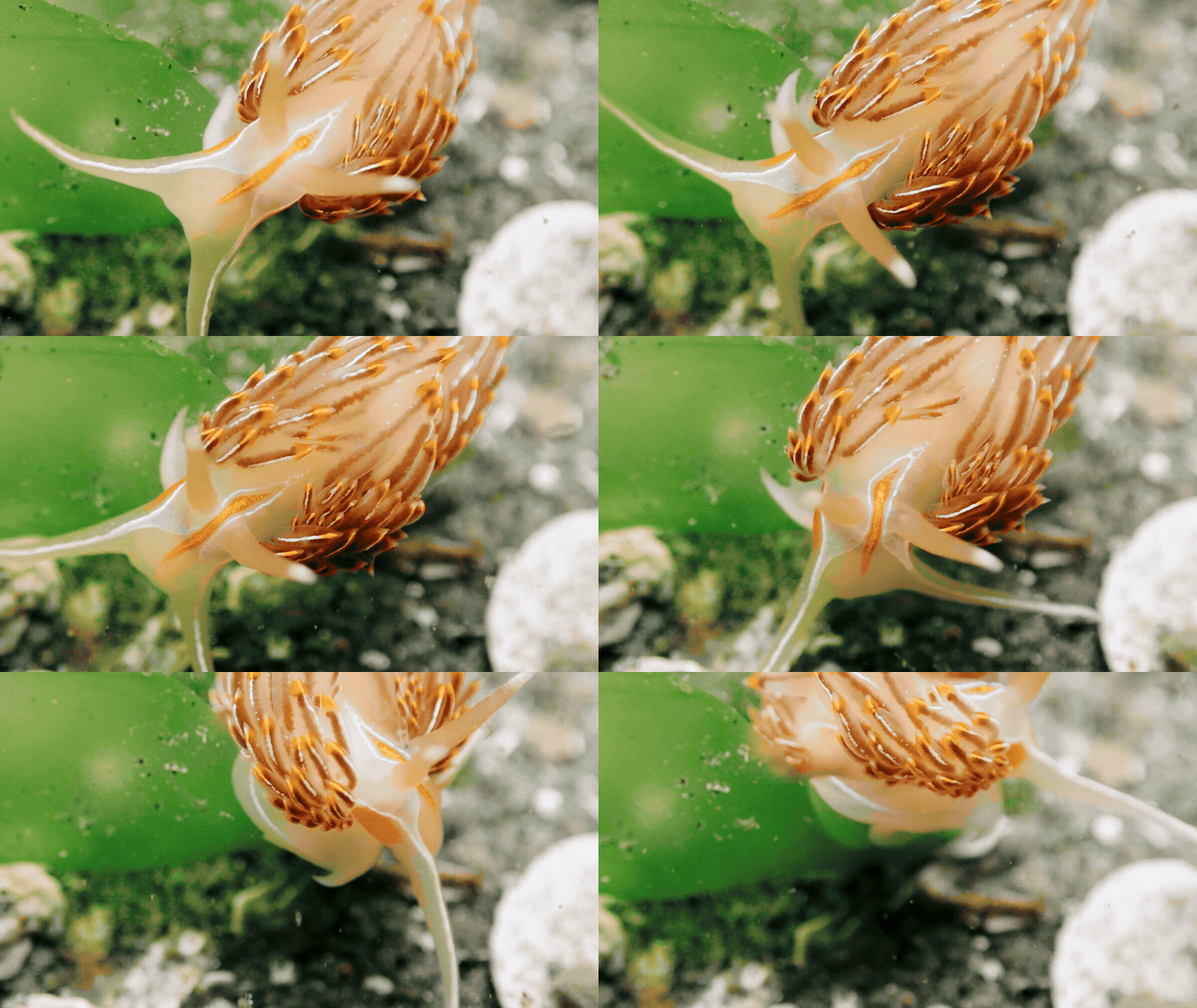
(GIF: Sara Montour Lewis / Our Wild Puget Sound)
The Tide Pool Teaches the Method
Here is what I love about the Hermissenda story: It doesn’t make science look weak. It makes science look alive.
Science is not a fortress where knowledge sits unchanging behind stone walls. It’s a shoreline. It’s a place where the boundary between what we know and what we don’t know is constantly being rewritten by the tide.
At one time Eolis crassicornis was a reasonable starting point. Then Phidiana crassicornis was a reasonable correction. Then Hermissenda crassicornis became the best-supported placement. Then genetics arrived and said, politely but firmly: You’re still missing something. And just to complicate matters further, what had long been grouped under Hermissenda crassicornis in the eastern Pacific had a close, long-confused counterpart in the northwestern Pacific — now recognized as its own species, Hermissenda emurai.
This is not failure. This is the method working as designed. The world is complicated. Our categories are provisional. And reality keeps insisting we refine them. Sometimes that refinement comes from microscopes and dissections. Sometimes it comes from DNA sequencing and phylogenetic trees. Sometimes it comes from the quiet persistence of someone who refuses to accept “obviously” as an answer.
But it always starts the same way: Someone looks closely and admits they might be wrong.
And Now the Part Where You Get Involved
If you’ve never looked for nudibranchs in a tide pool, I’m going to make a pitch: Go.
Go on an ordinary day. Go with a friend. Go with a kid who will ask better questions than you. Go with no agenda except curiosity and some decent shoes you don’t mind ruining.
Because there is something profoundly human — maybe even profoundly necessary — about kneeling down at the edge of the sea and letting the small things reframe you.
A nudibranch is an organism so alien-looking that it breaks the part of your brain that thinks nature should be familiar. It forces a reset. It reminds you that the ocean is not scenery. It is an evolutionary engine that has been inventing forms longer than we’ve been inventing excuses.
And if you’re lucky, you’ll find one of these Hermissenda — or what you think is one — moving slowly through the miniature universe of a tide pool. You might even say its name out loud. Not as a way of closing the case, but as a way of opening it.
Because now that you know the story, the name becomes a question again.
Is it H. crassicornis?
Is it H. opalescens?
What did this animal get called in older guides?
What did it get miscalled in old papers?
What else are we still missing, hiding in plain sight, inside our best-loved certainties?
That is not a cause for despair. That is a reason to pay attention.
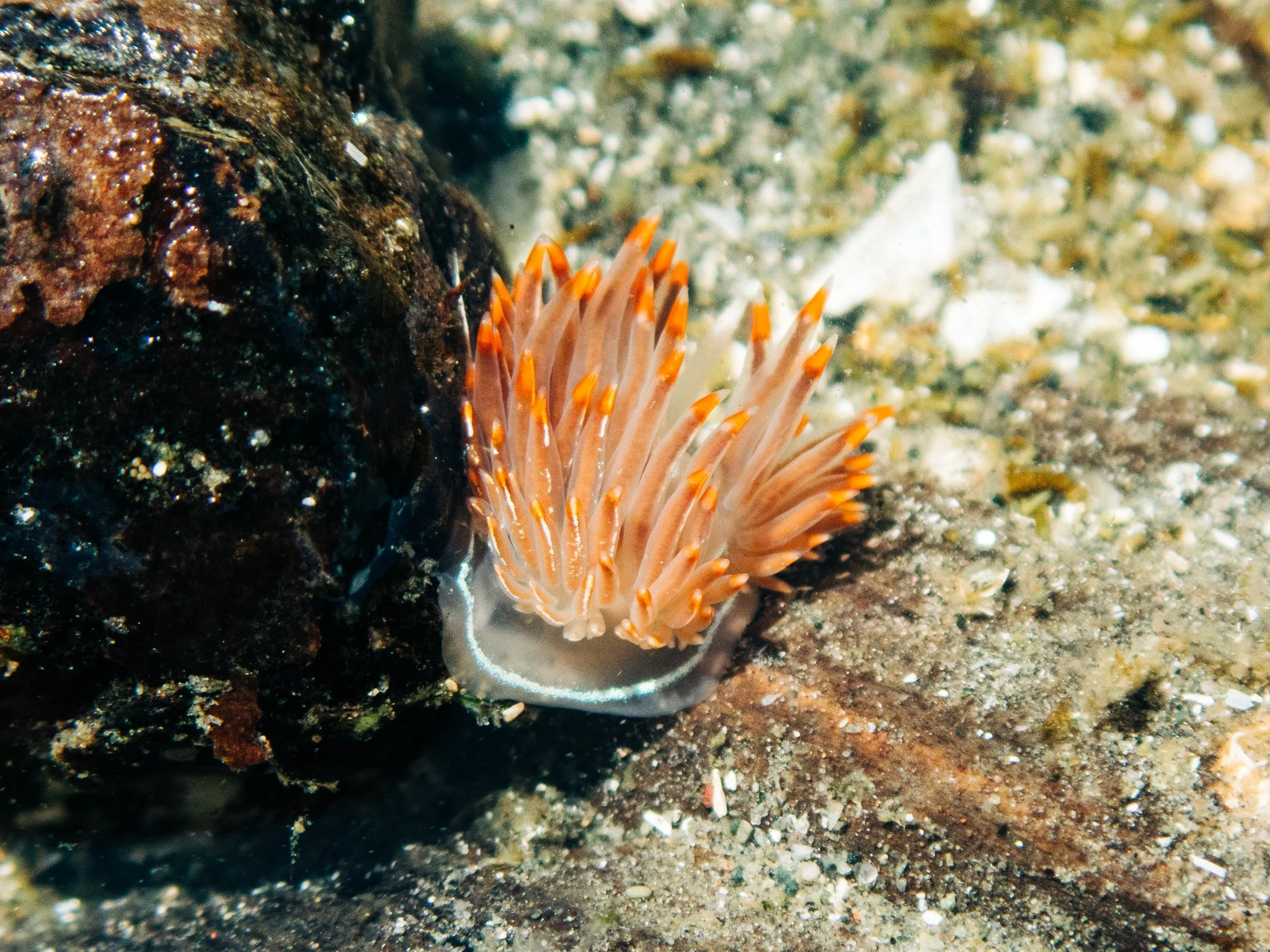
A thick-horned nudibranch on the beach at Mukilteo Lighthouse Park (Photo: Sara Montour Lewis / Our Wild Puget Sound)
The Profound Lesson: Accuracy Is a Kind of Humility
There’s a line people sometimes toss around when they talk about science: that it’s cold, clinical, detached.
The tide pool disagrees.
The truth is that science — real science — is intimate. It requires closeness. It requires care. It requires the willingness to have your mental model dismantled by a creature the size of your thumb.
And perhaps the deepest lesson in this whole naming saga is this: Our job is not to dominate nature with labels. Our job is to keep updating our labels in obedience to nature. That’s the relationship.
Observation first.
Then hypothesis.
Then revision.
Then better observation.
Then the next revision.
And if we’re lucky, we don’t just end up with a cleaner taxonomy. We end up with better humility. Better questions. Better protection.
Because conservation is not only about charisma and crisis. It’s also about precision. About knowing what, exactly, is alive on a given stretch of coast — and how many kinds of “the same thing” we’ve been overlooking because we didn’t look long enough.
This is what the ocean teaches, again and again: That the world is richer than our first draft of it.
So go to the tide pools. Bring your patience. Bring your curiosity. Bring your willingness to be wrong. And when you find something that looks like a flame learning to crawl, don’t rush past it. Kneel down. Take a closer look. The ocean might be trying to tell you a new name.